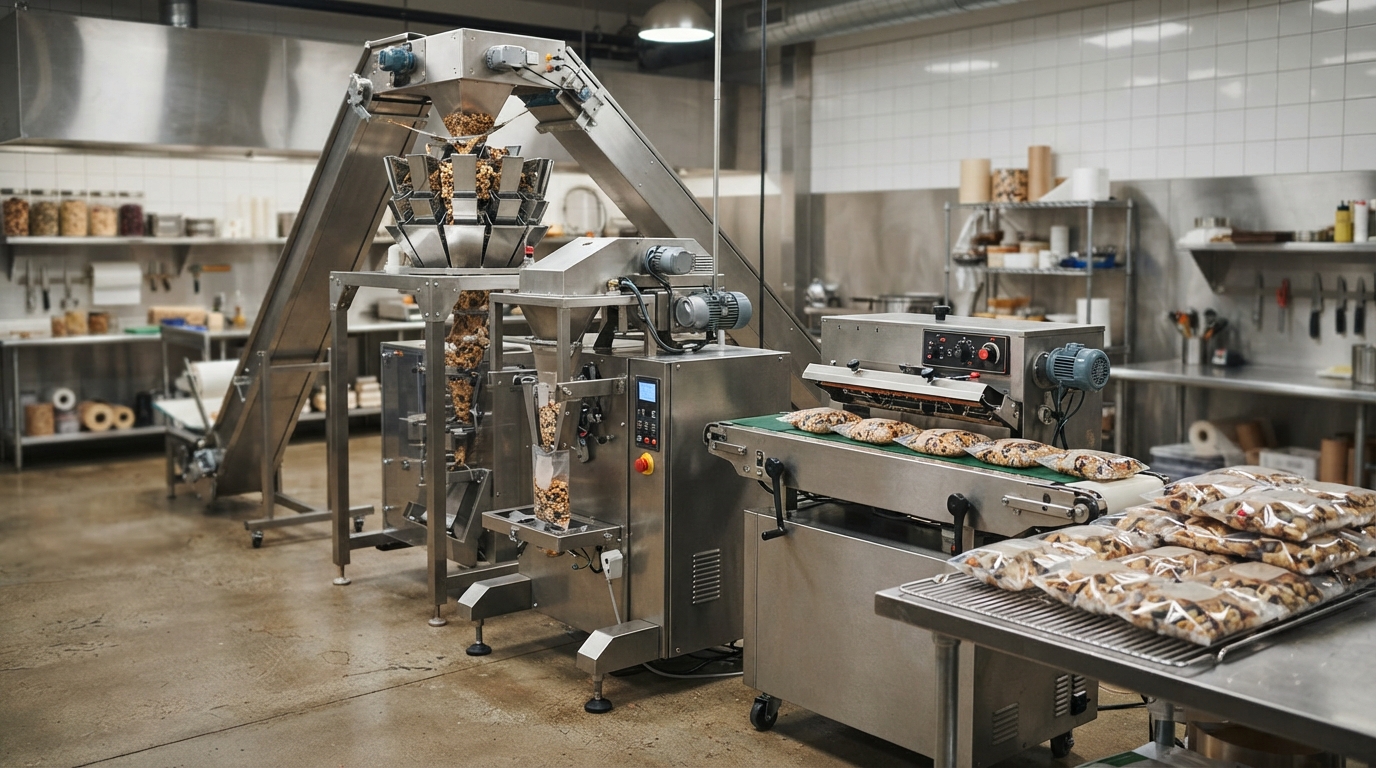
Packaging is one of the final stages of food manufacturing, but it plays an important role in preparing products for sale, storage, transportation, and distribution.
Commercial packaging machines help businesses package food more consistently, reduce manual handling, improve production efficiency, and prepare products for different retail and wholesale markets.
Small food manufacturers may need only a few machines to package their products, while larger operations may use automated systems connected to production lines.
Food sealing machines
Sealing machines are used to close packages and help protect products from contamination, moisture, air exposure, and handling.
Different types of sealing equipment are designed for different packaging materials and applications.
Common options include:
- Impulse sealers
- Continuous band sealers
- Tray sealing machines
- Vacuum packaging machines
- Heat sealing systems
Impulse sealers are often used for small production operations because they can seal compatible plastic packaging without requiring a large automated system.
Continuous band sealers are designed to process bags repeatedly, making them useful for businesses packaging larger quantities of products.
Vacuum packaging machines
Vacuum packaging machines remove air from packaging before sealing.
They are commonly used for meat, cheese, prepared foods, coffee, specialty products, and other items where packaging conditions are important.
Commercial vacuum machines are available in external models and chamber systems.
External vacuum machines may suit certain small-scale applications, while chamber machines are often used for a broader range of commercial packaging requirements.
Businesses should evaluate package dimensions, product characteristics, sealing speed, vacuum performance, and cleaning requirements.
Food weighing and portioning equipment
Accurate weighing is important when packaging food products for retail sale or wholesale distribution.
Commercial weighing systems can measure ingredients, portions, and finished packages.
Depending on the operation, businesses may use bench scales, portioning machines, filling systems, multihead weighers, or integrated weighing and packaging equipment.
Automated weighing systems can help reduce product variation and improve packaging consistency.
The machine should be suitable for the product’s shape, size, texture, and handling characteristics.
Filling and packaging machines
Businesses packaging liquids, powders, granules, or solid products may require specialized filling equipment.
Liquid filling machines are used for beverages, oils, sauces, and other liquid products.
Powder filling systems are designed for ingredients such as flour, spices, coffee, and powdered food products.
Granule filling machines can package products such as rice, seeds, grains, snacks, and similar materials.
The packaging format, product density, container size, and required accuracy influence machine selection.
Labeling and date coding machines
Labels provide product information, branding, ingredients, instructions, and other details required for retail and commercial distribution.
Commercial labeling machines can apply labels to bottles, jars, containers, bags, and packages.
Date coding equipment can print manufacturing dates, expiration information, lot numbers, and other production details.
Small manufacturers may use tabletop labeling machines, while larger businesses may integrate automatic labeling systems into production lines.
Choosing packaging equipment for a small food business
Packaging requirements depend on the product and how it will be sold.
A business selling homemade-style snacks through local retailers may need sealing, weighing, and labeling equipment.
A manufacturer supplying supermarkets may require more consistent packaging dimensions, faster production speeds, and additional automation.
Before buying machines, evaluate packaging materials, package sizes, production volume, operating costs, cleaning requirements, maintenance, and available space.
Building an efficient packaging operation
Packaging equipment should be selected as part of the overall production process.
If packaging is too slow, finished products may accumulate before they are ready for distribution.
A properly designed packaging setup can help businesses maintain production flow, improve consistency, reduce handling, and prepare products for retail or wholesale customers.
Read More:

Be First to Comment