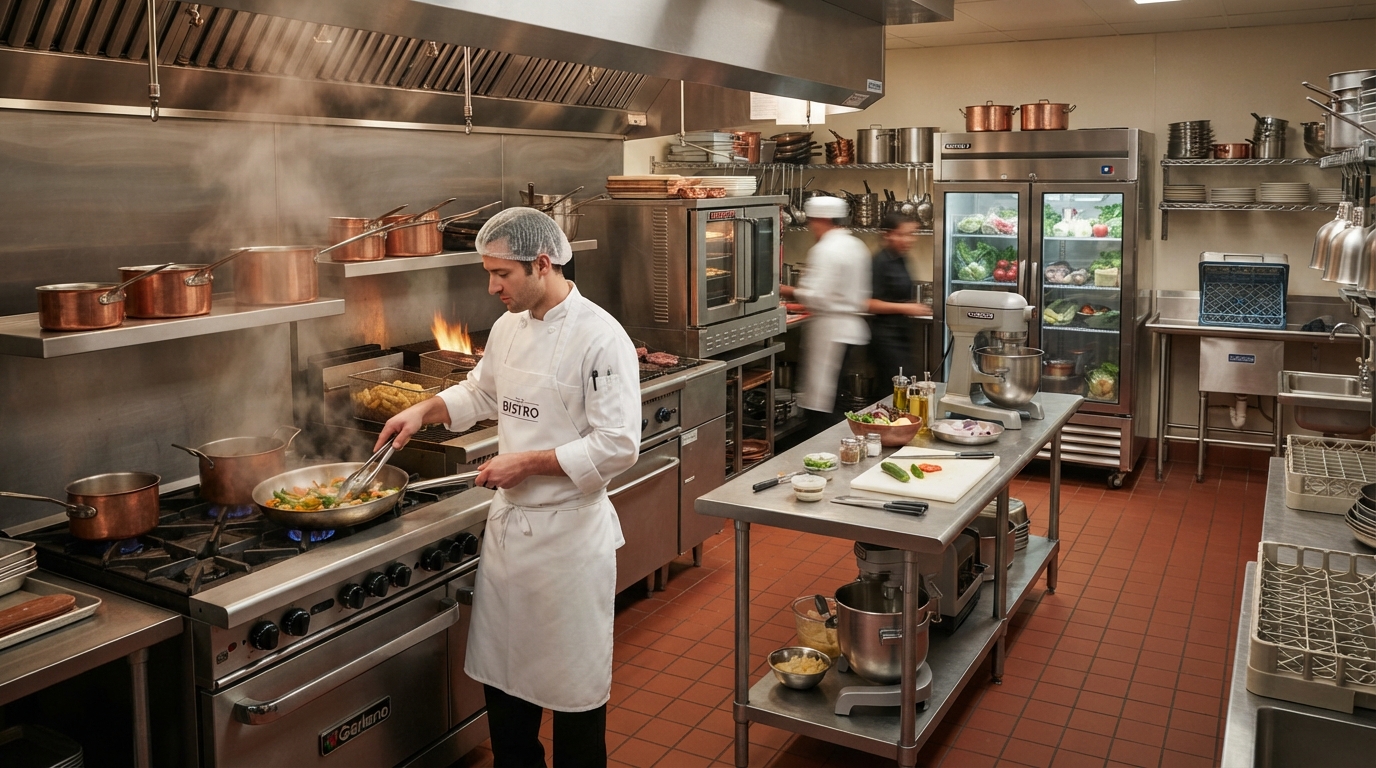
Opening a restaurant requires more than a good menu and an attractive location. The kitchen needs reliable equipment capable of handling daily orders, maintaining food safety, and supporting consistent production. Choosing the right machines from the beginning can help control operating costs, reduce unnecessary labor, and avoid expensive upgrades as the business grows.
Cooking Equipment
Cooking equipment is the foundation of a commercial kitchen. The selection depends on the menu, expected demand, and available space.
Commercial ranges, convection ovens, griddles, fryers, salamanders, and commercial pizza ovens are among the most common options. Restaurants that prepare different types of meals may require several cooking stations, while businesses focused on a limited menu can often operate efficiently with fewer machines.
A convection oven is particularly useful for kitchens that need consistent cooking across multiple trays. Commercial fryers are essential for businesses serving fried foods, while griddles are frequently used in breakfast restaurants, burger shops, and sandwich operations.
Refrigeration and Food Storage
Commercial refrigeration is essential for preserving ingredients and maintaining safe kitchen operations. Refrigerators, freezers, refrigerated preparation tables, and walk-in coolers help restaurants organize ingredients and maintain temperature control.
The capacity of refrigeration equipment should be based on daily purchasing volume, menu requirements, and available storage space. Buying a refrigerator that is too small can create operational problems, while oversized equipment may increase electricity costs unnecessarily.
Food Preparation Machines
Food preparation equipment can reduce manual work and improve consistency. Commercial mixers, food processors, vegetable cutters, meat slicers, dough mixers, and blenders help kitchens prepare ingredients more efficiently.
Restaurants producing large quantities of dough, sauces, vegetables, or meat may benefit significantly from specialized equipment. The right machine can reduce preparation time and allow employees to focus on cooking, assembly, and service.
Dishwashing and Cleaning Equipment
Commercial dishwashers are designed to process large quantities of plates, utensils, trays, and kitchen equipment during busy operating periods. Depending on the business, an undercounter dishwasher, door-type machine, or conveyor system may be appropriate.
Restaurants should also consider stainless steel worktables, sinks, shelving, waste management equipment, and ventilation systems when planning the kitchen.
How to Choose the Right Equipment
Before purchasing commercial kitchen equipment, restaurant owners should evaluate:
- The type of food being served
- Expected daily customer volume
- Available kitchen space
- Electrical, gas, and plumbing requirements
- Equipment dimensions and installation needs
- Warranty and technical support
- Cleaning and maintenance requirements
- Energy consumption
Buying equipment based only on its initial price can lead to higher expenses over time. Reliability, service availability, capacity, and operating costs should also influence the decision.
Building a Kitchen That Can Grow
A restaurant kitchen should be designed around its actual workflow. Cooking, preparation, refrigeration, cleaning, and food storage areas should be arranged to minimize unnecessary movement.
The best commercial kitchen is not necessarily the one with the most equipment. It is the one with machines that match the menu, workload, space, and business model.
Careful equipment selection gives restaurant owners a stronger foundation for daily operations and future expansion.
Read More:

[…] Essential commercial kitchen equipment for starting a restaurant […]
[…] Essential commercial kitchen equipment for starting a restaurant […]
[…] Essential commercial kitchen equipment for starting a restaurant […]
[…] Essential commercial kitchen equipment for starting a restaurant […]