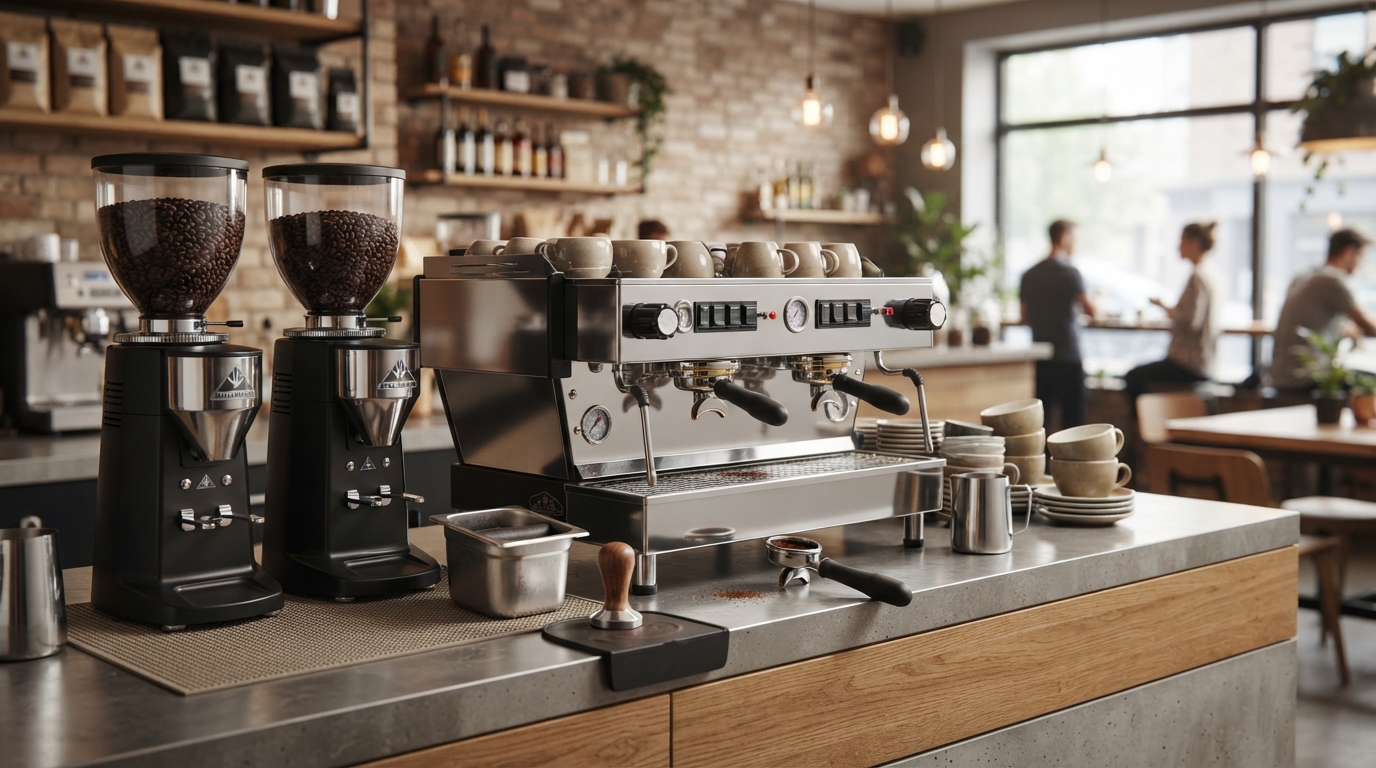
Opening a coffee shop requires careful planning, particularly when selecting the equipment responsible for producing drinks throughout the day. The quality, capacity, and reliability of commercial coffee equipment directly affect service speed, beverage consistency, operating costs, and customer satisfaction.
A small coffee shop may need only a few essential machines, while a high-volume location requires equipment capable of handling dozens or hundreds of orders during busy periods. Understanding the main options helps business owners build a coffee operation that fits their budget and expected demand.
Commercial espresso machines
The espresso machine is usually the centerpiece of a traditional coffee shop. It determines how many drinks employees can prepare simultaneously and how efficiently the business handles customer orders.
Commercial espresso machines are available in different configurations, including one-group, two-group, three-group, and four-group models.
A one-group machine may be suitable for a small coffee shop with limited demand, a mobile coffee operation, or a business that serves espresso drinks as part of a broader menu.
Two-group machines are common in small and medium-sized cafés because they allow baristas to prepare multiple drinks simultaneously without occupying excessive counter space.
Three-group and four-group machines are designed for busy establishments with greater beverage volume and multiple baristas working at the same time.
When comparing espresso machines, consider boiler capacity, temperature stability, steam power, automatic controls, cleaning requirements, and available service support.
Commercial coffee grinders
Coffee grinders are as important as espresso machines because grind consistency affects extraction, flavor, and the quality of each beverage.
Commercial grinders are designed for repeated use throughout the day and generally offer faster grinding speeds, more durable components, and more precise adjustment systems than household models.
Coffee shops may use separate grinders for espresso and other brewing methods. Some businesses also maintain additional grinders for decaffeinated coffee or specialty beans.
Important features include:
- Grind adjustment precision
- Grinding speed
- Burr type and durability
- Dose consistency
- Hopper capacity
- Ease of cleaning
A grinder should be capable of supporting the expected volume of coffee without becoming a bottleneck during peak service.
Water filtration systems
Water quality has a significant effect on coffee flavor and equipment performance. Mineral content, hardness, and impurities can influence extraction and contribute to scale buildup inside espresso machines.
Commercial water filtration systems are designed to improve water quality while helping protect expensive coffee equipment.
Common options include carbon filtration, scale reduction systems, reverse osmosis systems, and specialized filtration solutions designed for commercial coffee applications.
The appropriate system depends on the local water supply, the espresso machine manufacturer’s requirements, and the type of beverages being served.
Water filtration should be considered before installing an espresso machine because the plumbing and filtration setup can affect installation costs and long-term maintenance.
Additional equipment for coffee shop operations
An espresso machine and grinder are not the only equipment required to operate a coffee shop.
Depending on the menu, businesses may also need:
- Commercial batch coffee brewers
- Hot water dispensers
- Milk refrigerators
- Ice machines
- Commercial blenders
- Coffee scales
- Knock boxes
- Pitchers and steaming accessories
- Cup sealing machines
- Refrigerated display cases
Coffee shops serving iced drinks, smoothies, tea, sandwiches, and pastries may require additional equipment to support those products.
The menu should be established before purchasing machines because unnecessary equipment can consume valuable counter space and startup capital.
Choosing equipment based on customer volume
Expected customer volume is one of the most important factors when selecting commercial coffee equipment.
A small neighborhood café may prioritize compact machines, lower energy consumption, and manageable maintenance costs.
A coffee shop located near offices, universities, transportation stations, or busy shopping areas may need higher-capacity machines capable of producing drinks continuously during morning and afternoon rushes.
Equipment that is too small can create long queues and lost sales. Equipment that is too large can increase initial investment, operating costs, and unused capacity.
Buying new, used, or refurbished coffee equipment
New equipment provides access to warranties, current technology, and manufacturer support. It may also be easier to finance or obtain through authorized commercial dealers.
Used equipment can reduce startup expenses, particularly for businesses operating on a limited budget.
Refurbished machines may offer an alternative between new and used equipment when they have been inspected, repaired, and tested by qualified technicians.
Before purchasing, evaluate the machine’s condition, service history, replacement parts availability, installation requirements, and the reputation of the seller.
Building an efficient coffee shop setup
The best coffee shop equipment setup balances beverage quality, production capacity, available space, and investment.
Rather than buying every machine available, business owners should prioritize the equipment needed for their menu and expected sales volume. A carefully planned setup can improve workflow, reduce waste, and create a more reliable operation as the coffee shop grows.
Read More:

Be First to Comment