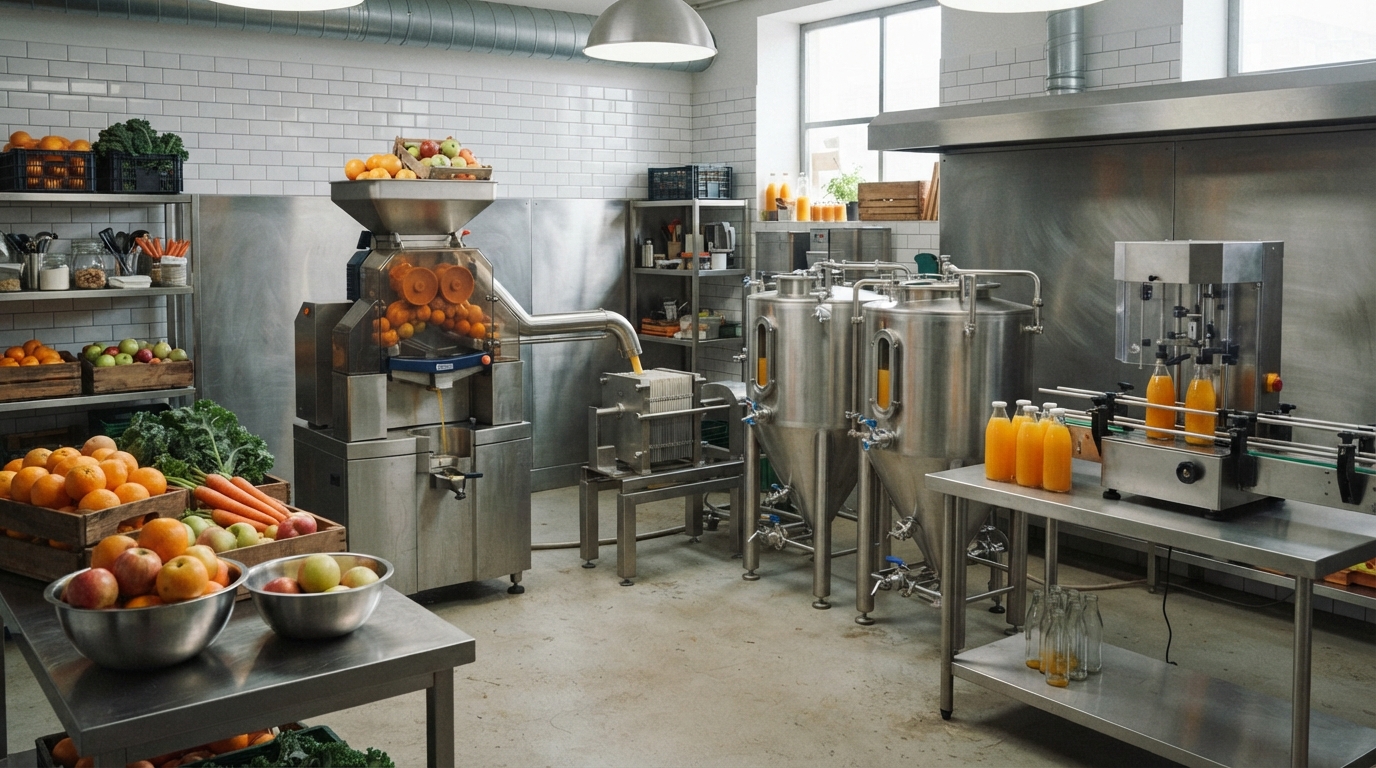
Juice production can be an opportunity for small businesses interested in manufacturing beverages for retail, restaurants, cafés, local markets, and direct customers.
Commercial juice processing equipment allows businesses to transform fresh fruits and vegetables into beverages through several stages, including washing, preparation, extraction, filtration, mixing, storage, and packaging.
The machines required depend on the ingredients, juice type, production volume, packaging format, and intended distribution.
Fruit washing and preparation equipment
The first stage of juice production involves preparing raw ingredients.
Fruit and vegetable washing machines are designed to remove dirt and other unwanted material from ingredients before processing.
Depending on the type of fruit, a production operation may also require peeling machines, sorting systems, cutting machines, conveyors, and preparation tables.
Some fruits require minimal preparation, while others may need to be peeled, separated, or cut before juice extraction.
Preparation equipment should be selected based on the ingredients being processed and the expected daily volume.
Commercial juice extraction machines
Juice extraction equipment separates liquid from fruits and vegetables.
Different machines are designed for different ingredients and production methods.
Citrus juicers are commonly used for oranges, lemons, limes, and other citrus fruits.
Fruit presses are used for certain fruits and may be suitable for producing juice from apples, grapes, berries, and other ingredients depending on the machine design.
Industrial juice extractors may be designed to process larger quantities of fruits and vegetables continuously.
When comparing extraction machines, businesses should evaluate output capacity, extraction efficiency, cleaning requirements, product quality, ingredient compatibility, and maintenance.
Juice filtering and blending equipment
Some juice products require filtering to remove pulp, seeds, or other solids.
Filtering equipment can help produce beverages with a more uniform texture and appearance.
Commercial blending systems are used to combine ingredients, flavors, juices, concentrates, water, and other components.
Depending on the product, manufacturers may use mixing tanks, industrial blenders, homogenizers, or specialized beverage processing equipment.
The equipment should be capable of handling the product formulation without compromising its intended texture or consistency.
Commercial juice storage tanks
Storage tanks are used during different stages of beverage production.
Businesses may need tanks for freshly extracted juice, blended products, ingredients, or preparation before filling.
Commercial tanks may include stainless steel construction, temperature controls, mixing systems, drainage connections, and other features depending on the production requirements.
Storage capacity should be based on production volume, processing time, filling capacity, and the intended handling of the beverage.
Juice filling and bottling equipment
Packaging is an important part of juice production.
Small businesses may use manual or semi-automatic filling machines to transfer juice into bottles, containers, or other packaging formats.
Larger operations may use automated filling systems integrated with conveyors, capping machines, labeling equipment, and packaging lines.
The filling equipment should be compatible with the juice characteristics, container type, required filling volume, cleaning procedures, and production capacity.
Businesses producing beverages for distribution may also need additional packaging equipment and systems designed to support their product handling and storage requirements.
Equipment for starting a small juice business
A small juice manufacturer may begin with fruit preparation equipment, a commercial extractor, a mixing or storage system, a filling machine, and basic packaging equipment.
The exact setup depends on whether the business produces fresh juice for immediate consumption, bottled juice for retail, juice concentrates, blended beverages, or other products.
Entrepreneurs should consider ingredient sourcing, production volume, equipment cleaning, food safety, storage, packaging, operating costs, and applicable regulations before purchasing machinery.
Choosing the right juice production machines
Commercial juice processing equipment should be selected according to the product and the production process.
A business focused on fresh citrus juice may require a different setup from one producing mixed fruit beverages or packaged vegetable juices.
Starting with equipment suited to the initial product range can help businesses control investment and establish production.
Additional machines can be introduced as demand increases and the operation moves toward larger-scale manufacturing.
Read More:


Be First to Comment