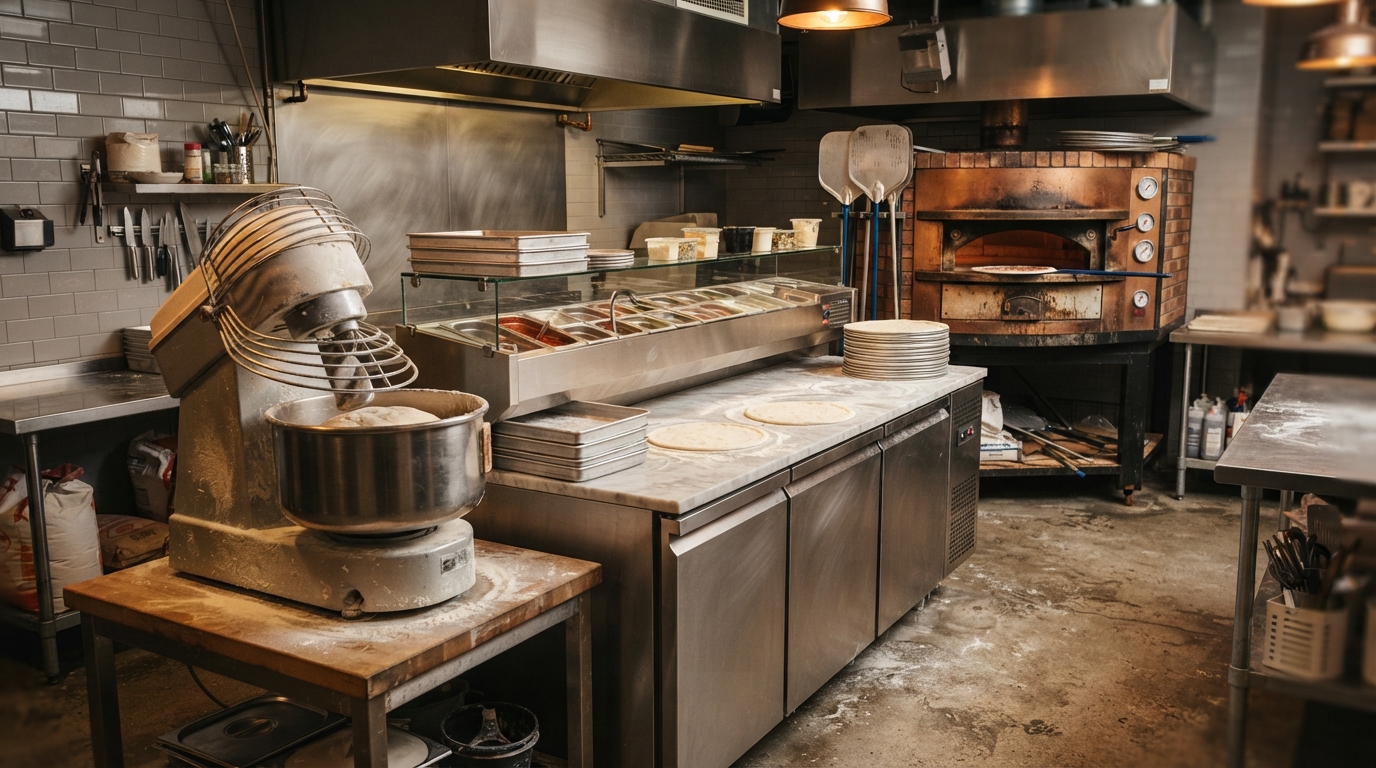
Starting a pizza business requires equipment capable of preparing dough, storing ingredients, assembling pizzas, baking products consistently, and handling orders efficiently.
A small takeaway operation may need a relatively simple setup, while a busy pizzeria or delivery business may require larger ovens, multiple preparation stations, refrigeration systems, and specialized dough equipment.
Choosing the right pizza making equipment can help business owners improve production speed, maintain consistent quality, and control operating costs.
Commercial pizza ovens
The commercial pizza oven is one of the most important investments in a pizza business.
Different ovens offer different baking characteristics, capacities, operating costs, and installation requirements.
Common commercial pizza oven types include:
- Deck pizza ovens
- Conveyor pizza ovens
- Wood-fired pizza ovens
- Gas pizza ovens
- Electric pizza ovens
Deck ovens are widely used in pizzerias because they allow pizzas to be baked directly on heated surfaces.
Conveyor ovens move pizzas through a heated chamber at a controlled speed. They can be useful for operations requiring consistent output and simplified production.
Wood-fired ovens are often chosen for businesses that want a specific cooking style and customer experience, although they may require additional attention to fuel, ventilation, temperature management, and operating procedures.
The oven should be selected based on pizza style, expected orders, cooking time, available space, energy source, and production capacity.
Commercial pizza dough mixers
Pizza dough preparation can become labor-intensive when a business produces large quantities.
Commercial spiral mixers are commonly used to mix pizza dough because they are designed to handle heavier doughs and repeated production cycles.
Mixer capacity should be based on the quantity of dough required per batch rather than bowl size alone.
Business owners should consider mixing capacity, motor performance, speed options, dough temperature, cleaning, and the number of batches required during a typical operating day.
Pizza dough presses and sheeters
Dough presses and sheeters help businesses produce pizza bases with consistent thickness and dimensions.
Dough presses flatten portions into round bases, while sheeters can roll dough into uniform sheets.
These machines may reduce preparation time and improve consistency when producing large quantities of pizza bases.
Some businesses prefer manual shaping because it allows greater control over the dough and product characteristics.
The choice depends on the pizza style, production volume, staff experience, and desired consistency.
Refrigeration and pizza preparation tables
Pizza preparation tables combine refrigerated storage with a working surface for assembling pizzas.
They may include ingredient containers, refrigerated compartments, drawers, shelves, and stainless steel work surfaces.
These systems allow employees to access toppings, sauces, cheese, and other ingredients without repeatedly moving between preparation and storage areas.
Additional equipment may include commercial refrigerators, freezers, ingredient storage containers, and dough refrigeration systems.
Additional equipment for a pizzeria
A pizza business may also require:
- Commercial pizza cutters
- Dough trays
- Pizza screens
- Pizza peels
- Ingredient scales
- Food processors
- Vegetable slicers
- Dough portioning equipment
- Commercial ventilation
- Packaging and delivery supplies
Equipment requirements depend on whether the business operates as a dine-in restaurant, takeaway counter, delivery kitchen, or production facility.
How to choose pizza equipment
Before purchasing machines, business owners should estimate the number of pizzas they expect to produce during normal and peak hours.
A machine that cannot keep up with demand may create delays and lost sales.
At the same time, purchasing equipment with excessive capacity can increase investment and operating expenses before the business has enough customers.
Other important considerations include available space, installation requirements, energy consumption, cleaning, maintenance, and replacement parts.
Planning a pizza production setup
A well-designed pizzeria should allow dough preparation, ingredient storage, pizza assembly, baking, cutting, and packaging to flow efficiently.
The best pizza equipment setup is not necessarily the largest or most automated. It is the combination of machines that supports the menu, expected orders, product quality, and business model.
Starting with reliable essential equipment and expanding as demand grows can help a pizza business manage costs while building production capacity.
Read More:

Be First to Comment