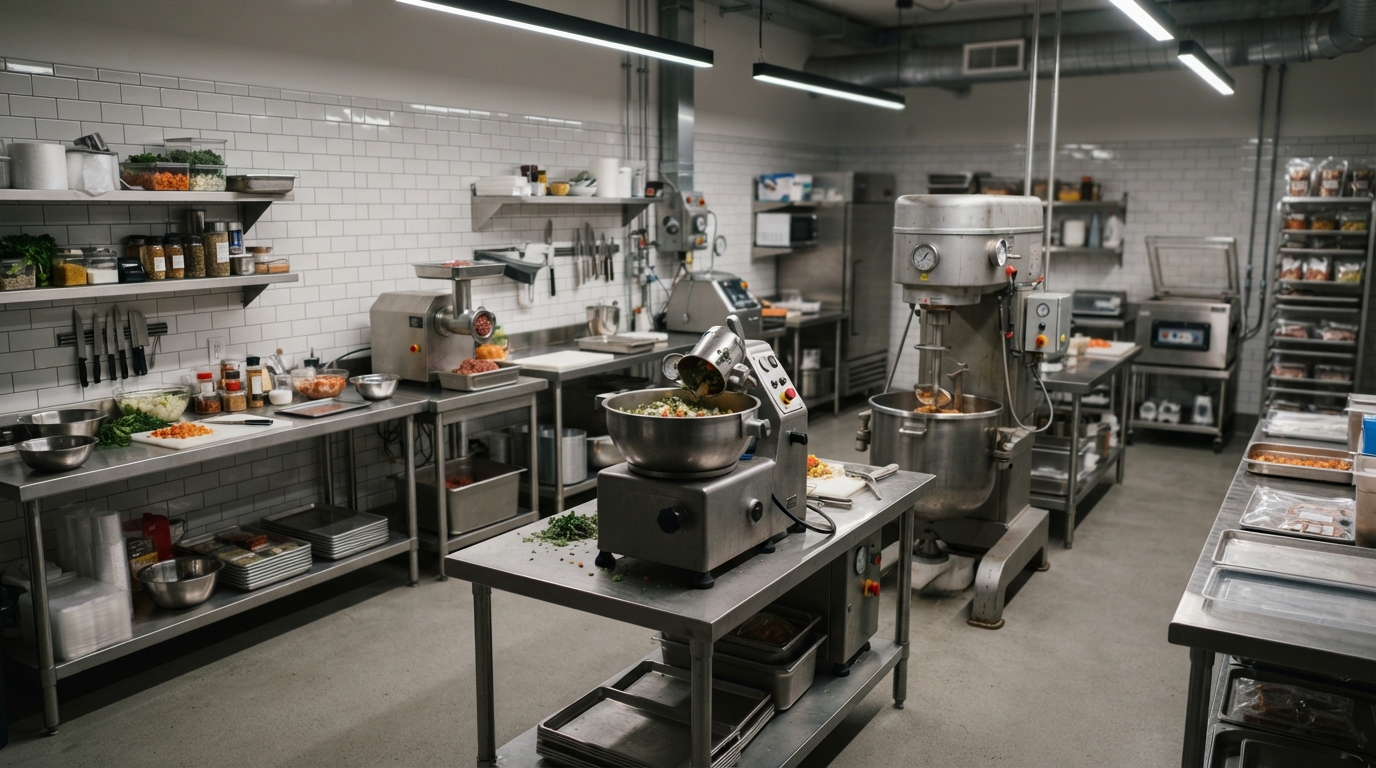
Food processing machines allow small businesses to transform raw ingredients into products that can be prepared, packaged, and sold more efficiently. These machines are used in operations producing sauces, snacks, baked goods, frozen foods, seasonings, prepared meals, and many other products.
For entrepreneurs entering food manufacturing, the equipment required depends on the type of product, production volume, ingredients, available space, and the level of automation.
Understanding the main categories of food processing machines can help businesses choose equipment that supports production without unnecessary investment.
Food preparation machines
Food preparation is often the first stage of a manufacturing process.
Machines used during preparation can clean, peel, cut, slice, shred, grind, or separate raw ingredients before they move into mixing, cooking, or packaging.
Common equipment includes:
- Vegetable washing machines
- Commercial peelers
- Food slicers
- Vegetable cutters
- Food choppers
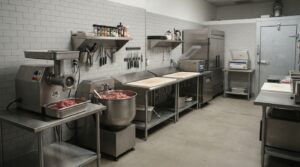
- Meat grinders
- Industrial food processors
These machines can reduce manual preparation time and improve consistency when processing larger quantities of ingredients.
The appropriate equipment depends on the type of raw material and the required size, shape, or texture of the finished product.
Mixing and blending equipment
Mixing machines are used to combine ingredients into consistent formulations.
Small food manufacturers may use commercial mixers, industrial blenders, planetary mixers, ribbon blenders, or specialized mixing tanks.
These machines are commonly used to produce sauces, seasoning blends, doughs, fillings, batters, marinades, and other food products.
Different mixing technologies are designed for different materials. Dry ingredients, liquids, thick pastes, and products containing large pieces may require different equipment.
Businesses should consider mixing capacity, motor power, speed controls, cleaning procedures, material compatibility, and batch size.
Grinding and milling machines
Grinding equipment reduces ingredients into smaller particles or specific textures.
Food manufacturers use grinders and mills to process grains, spices, nuts, coffee, dried ingredients, and other materials.
Depending on the application, equipment may include hammer mills, commercial grinders, spice mills, grain mills, and pulverizers.
Particle size is an important factor because it can affect product texture, mixing, cooking performance, and consumer preference.
Small manufacturers should choose machines capable of producing the required consistency while handling the expected production volume.
Cooking and thermal processing equipment
Many food products require heating, cooking, melting, pasteurization, or temperature-controlled processing.
Commercial kettles, steam-jacketed kettles, cooking mixers, industrial fryers, ovens, and pasteurization systems are used in different food manufacturing applications.
Equipment selection depends on the product formulation, cooking method, batch size, temperature requirements, and production workflow.
Some machines combine mixing and heating, allowing manufacturers to process ingredients in a single vessel.
Food forming and production machines
Once ingredients are prepared and combined, some products require shaping or portioning.
Food forming equipment can produce consistent portions or shapes for products such as burgers, meatballs, cookies, pasta, snacks, dumplings, and other prepared foods.
Depending on the product, machines may include dough sheeters, food depositors, portioning machines, extruders, forming machines, and filling equipment.
Automated forming systems can help manufacturers improve product consistency and reduce repetitive manual work.
Packaging equipment for food manufacturers
Packaging is the final stage of many food production operations.
Small food businesses may use vacuum packaging machines, sealing machines, filling equipment, labeling systems, weighing machines, and date coding equipment.
Packaging requirements depend on the product, storage conditions, distribution method, and intended shelf life.
The packaging process should be considered when planning production because it can become a bottleneck even when preparation and processing machines have sufficient capacity.
Choosing food processing equipment
Before purchasing food processing machines, entrepreneurs should define the product they intend to manufacture and map the production process from raw ingredients to finished packaging.
Important considerations include:
- Production capacity
- Ingredient characteristics
- Machine dimensions
- Cleaning and sanitation
- Electrical requirements
- Operator training
- Spare parts availability
- Maintenance costs
- Food safety requirements
A small manufacturer may benefit from starting with a few versatile machines rather than purchasing a complete automated production line.
Building a small food manufacturing operation
Food processing machines can support a wide range of small businesses, from specialty sauces and snacks to packaged ingredients and prepared foods.
The most effective equipment setup is one designed around the product and the actual production process.
Choosing reliable machines with sufficient capacity, manageable operating costs, and room for future expansion can help a business develop a more efficient manufacturing operation.
Read More:

Be First to Comment