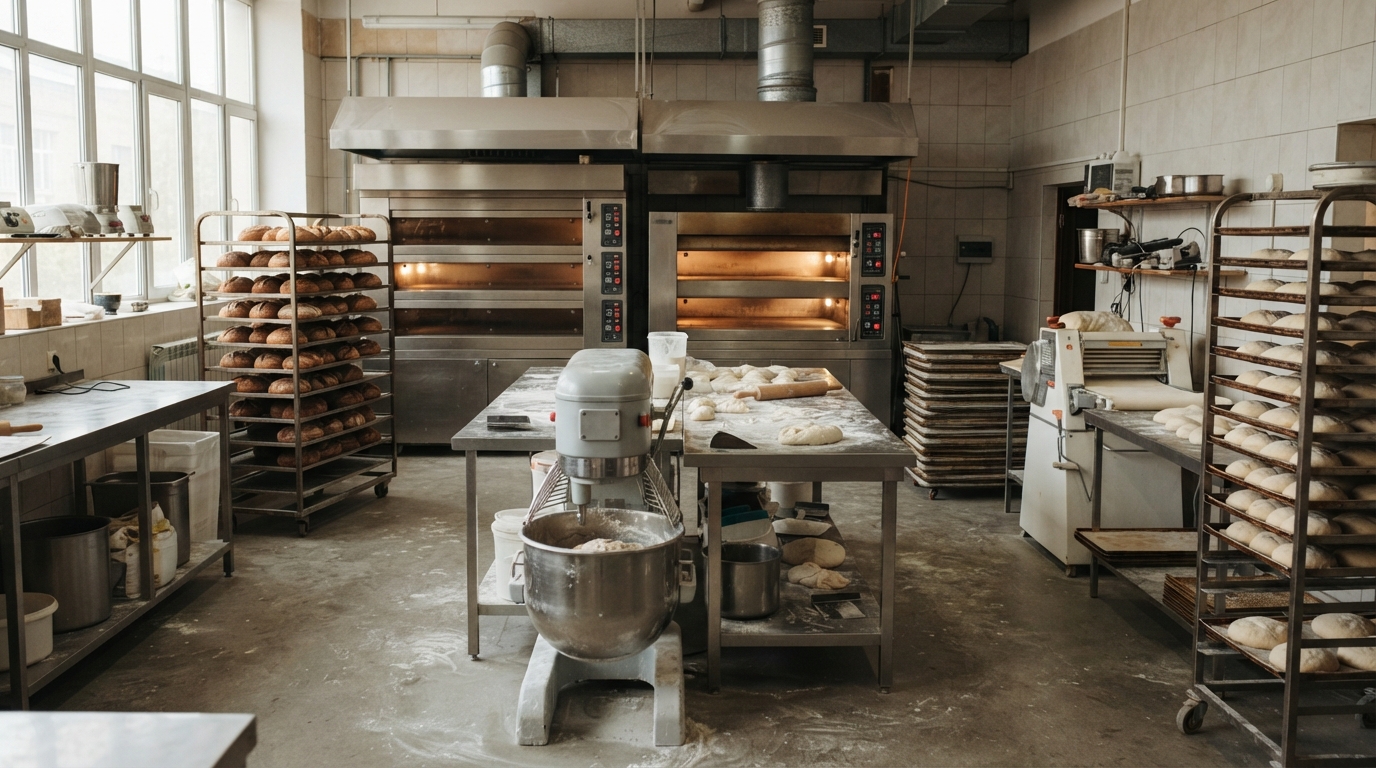
Starting a bakery requires more than recipes and quality ingredients. Producing bread, pastries, cakes, and other baked goods consistently requires equipment capable of handling preparation, mixing, shaping, baking, cooling, and storage.
The right commercial bakery equipment can help a small bakery increase production, reduce repetitive manual work, maintain product consistency, and serve customers more efficiently. However, not every bakery needs a complete industrial production line from day one. Equipment selection should depend on the products being made, expected daily production, available space, and startup budget.
Commercial ovens for bakery production
Commercial ovens are among the most important investments in a bakery. Different oven technologies are designed for different products and production requirements.
Convection ovens use fans to circulate hot air, helping distribute heat throughout the baking chamber. They are commonly used for cookies, pastries, cakes, and other products that benefit from consistent airflow.
Deck ovens are frequently used for bread and products requiring specific heat characteristics. Their baking surfaces and temperature controls allow bakers to work with different doughs and recipes.
Rotary rack ovens are designed for larger production volumes. They allow multiple trays to rotate during baking, making them useful for bakeries producing large batches of bread, pastries, and other baked products.
The oven should be selected based on tray capacity, temperature range, energy source, production volume, and available installation space.
Commercial mixers and dough preparation machines
Mixing is a fundamental stage of bakery production. Commercial mixers allow businesses to prepare doughs, batters, creams, and other ingredients in larger quantities.
Common bakery mixers include:
- Spiral mixers for bread and pizza dough
- Planetary mixers for cakes, creams, and batters
- Dough kneaders for larger production requirements
- Dough dividers for portioning
- Dough rounders for shaping portions
A mixer that is too small can limit production, while an oversized machine may consume unnecessary space and capital.
Businesses should consider bowl capacity, motor power, mixing speed, available attachments, cleaning requirements, and the types of dough they intend to produce.
Dough sheeters and bakery forming equipment
Dough sheeters flatten dough to a consistent thickness and can reduce the time required to prepare products such as croissants, pastries, cookies, pizza bases, and laminated dough.
Some bakery operations may also require dough dividers, molding machines, bread slicers, dough depositors, or pastry forming equipment.
These machines can improve consistency and reduce manual work when production volume increases.
The equipment needed depends on the bakery’s product range. A bread-focused business may prioritize dough handling and fermentation equipment, while a pastry operation may require sheeters, specialized molds, and precise temperature control.
Refrigeration and proofing equipment
Temperature control is important throughout bakery production.
Commercial refrigerators and freezers help store ingredients, prepared dough, fillings, creams, and finished products.
Proofing cabinets provide controlled conditions for dough fermentation. Depending on the production process, bakeries may use basic proofers, retarder-proofers, or specialized fermentation systems.
These machines allow bakers to manage dough development, production schedules, and product consistency more effectively.
Bakery preparation and finishing equipment
A commercial bakery may also require stainless steel worktables, ingredient storage containers, weighing scales, baking trays, racks, cooling systems, and bread slicing machines.
Display equipment can be important for businesses selling directly to customers. Refrigerated displays may be required for products containing creams or other temperature-sensitive ingredients.
Packaging equipment may also be necessary for bakeries supplying supermarkets, cafés, restaurants, or wholesale customers.
How to choose equipment for a new bakery
Before buying bakery machines, business owners should determine which products they intend to manufacture and how many units they expect to produce each day.
A small bakery may begin with a commercial oven, mixer, refrigerator, worktables, and basic dough handling equipment.
A larger operation may require multiple ovens, automated mixing systems, dough forming equipment, proofing chambers, cooling racks, and packaging machines.
Installation requirements, electricity or gas connections, ventilation, maintenance, replacement parts, and energy consumption should also be considered.
Building a bakery that can grow
The best bakery equipment setup is one that supports the business’s production needs without creating unnecessary costs.
Starting with reliable machines that serve the core product range can help a bakery establish demand before expanding into more specialized equipment.
As production increases, additional mixers, ovens, forming machines, and packaging systems can be introduced to improve capacity and reduce bottlenecks.
Read More:


Be First to Comment