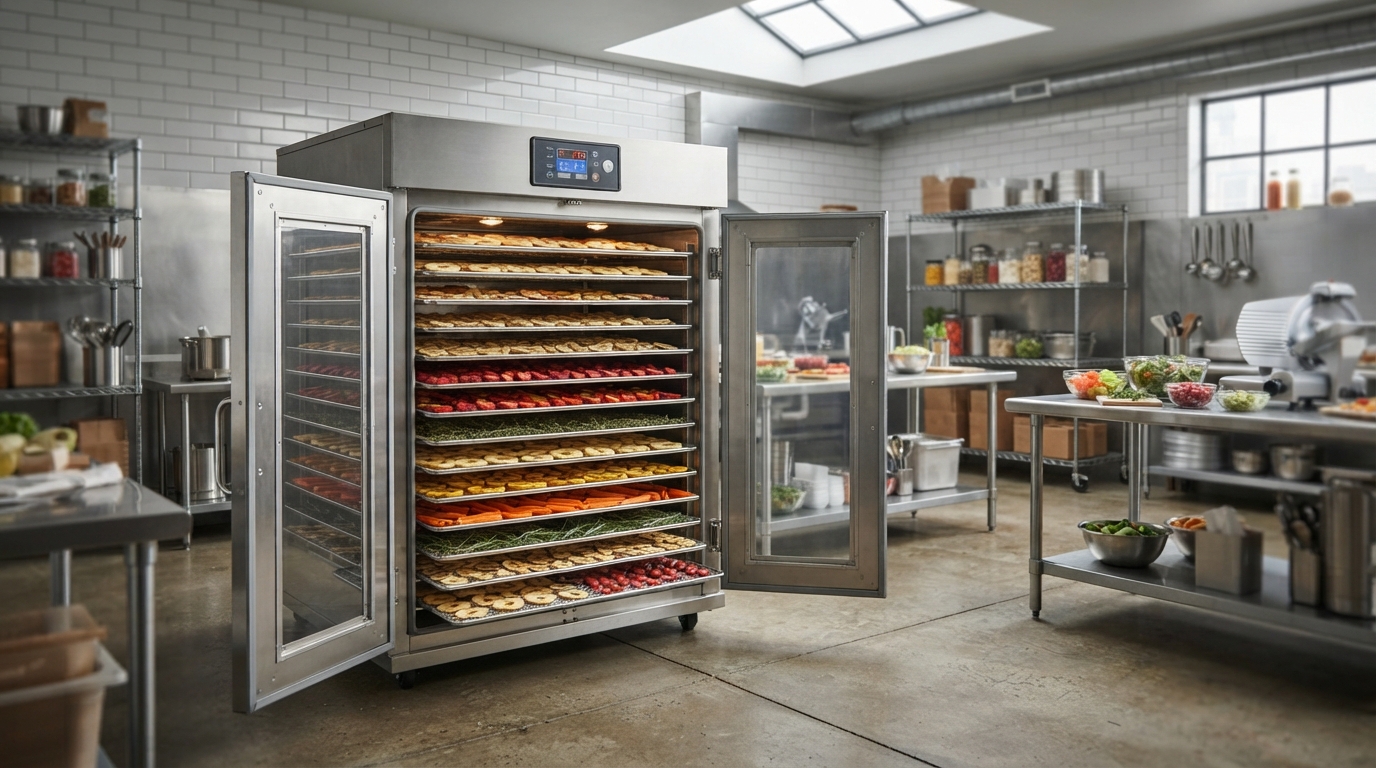
Food dehydration is a production method used to remove moisture from ingredients and create products with different textures, flavors, and storage characteristics.
Commercial food dehydrators allow small businesses to process fruits, vegetables, herbs, mushrooms, meats, and other ingredients in controlled conditions.
For entrepreneurs interested in manufacturing packaged snacks, dried ingredients, specialty foods, or preserved products, commercial dehydrating equipment can provide an opportunity to start production without building a large factory.
What products can commercial food dehydrators make?
Dehydrators are used across several food categories.
Businesses can produce:
- Dried fruit slices
- Fruit chips
- Vegetable snacks
- Dried herbs
- Mushroom products
- Beef jerky
- Dried spices
- Fruit powders
- Specialty ingredients
- Pet treats, where applicable and compliant with relevant requirements
Different products require different processing conditions. The thickness of the ingredients, moisture content, texture, and desired finished product all affect the drying process.
Some businesses focus on ready-to-eat snacks, while others supply dried ingredients to restaurants, bakeries, food manufacturers, or retailers.
Commercial dehydrator types
Commercial food dehydrators are available in different designs and capacities.
Tray dehydrators use multiple trays arranged inside a drying chamber. Heated air circulates around the food, gradually removing moisture.
Cabinet dehydrators are commonly used in small and medium-sized food production operations. They may offer larger capacities, temperature controls, and improved airflow systems.
Industrial drying systems may use conveyor belts or specialized drying technologies for continuous production.
The appropriate design depends on batch size, product type, available space, and the required production rate.
Capacity and airflow
Drying capacity affects how much product a business can process in a single cycle.
Machines with multiple trays can increase production, but tray capacity alone does not determine performance.
Airflow distribution, temperature consistency, tray spacing, moisture removal, and drying time all influence the quality of the finished product.
Business owners should consider how many kilograms of fresh ingredients can be processed per batch and how much finished product will remain after moisture removal.
This distinction is important when calculating production costs and expected revenue.
Features to look for in a commercial food dehydrator
Commercial dehydrators vary in size, construction, and operating features.
Important characteristics include:
- Adjustable temperature controls
- Airflow design
- Tray capacity
- Stainless steel construction
- Timer settings
- Moisture removal performance
- Energy consumption
- Cleaning requirements
- Maintenance and replacement parts
Some machines provide more precise temperature control or airflow management, which may be useful when processing different ingredients or products.
Additional equipment for a dehydration business
A food dehydration operation may require more than the dehydrator itself.
Depending on the production process, businesses may use:
- Food slicers
- Vegetable washers
- Cutting machines
- Preparation tables
- Weighing scales
- Food processors
- Packaging machines
- Vacuum sealers
- Labeling equipment
Uniform slicing can help improve drying consistency, while packaging equipment prepares finished products for sale.
How to start a food dehydration business
Before purchasing equipment, entrepreneurs should identify their product category and potential customers.
A business producing dried fruit snacks may require different preparation and packaging equipment from one producing herbs, mushrooms, or specialty ingredients.
Startup planning should consider ingredient sourcing, production capacity, drying time, packaging, storage, operating costs, applicable food safety regulations, and product shelf-life requirements.
Choosing the right dehydrator for production
The best commercial food dehydrator is one that can process the intended ingredients efficiently and consistently.
Small businesses may begin with a cabinet-style machine that offers manageable batch capacity and straightforward operation.
As demand increases, additional machines or larger drying systems may improve productivity.
The equipment should be selected based on actual production requirements rather than maximum advertised capacity alone.
Read More:


Be First to Comment